Follow Me On Social Media!

Danish Almond Puff: Buttery, Airy & Bakery-Style.

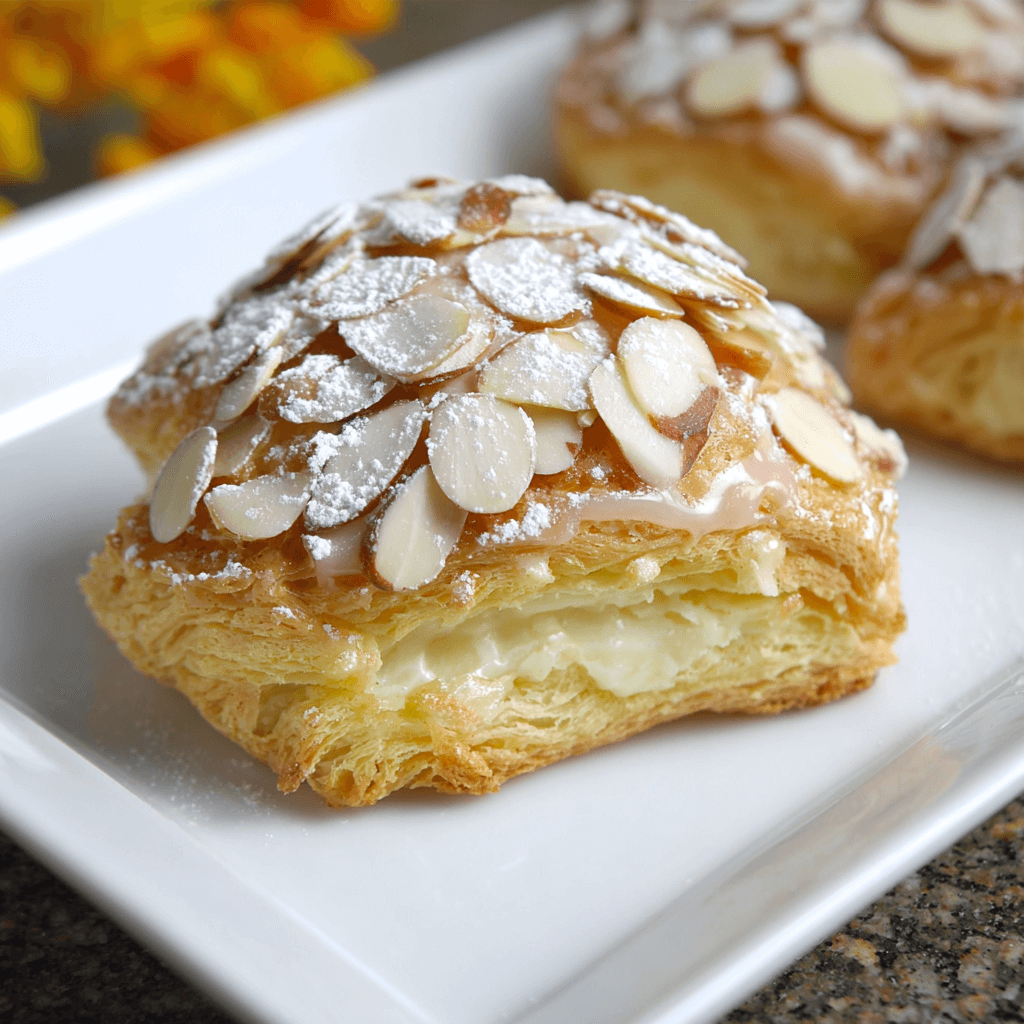
Often found in the small-town bakeries of the Midwest and Scandinavia, the Danish Almond Puff is a masterclass in textural contrast.1 It is a unique, two-layered pastry: the bottom is a flaky, shortbread-like crust, while the top is a light, airy “puff” (essentially a pâte à choux) that rises in the oven to create a custardy, hollow center.2
Finished with a sweet almond glaze and toasted slivered almonds, this isn’t just a pastry—it’s an elegant centerpiece for a weekend brunch or an afternoon “fika.”3 Despite its sophisticated appearance, it is surprisingly simple to make once you understand the “steam-rise” mechanics.
The Anatomy of the Puff
The secret to this recipe is the interaction between the dense base and the light top layer.
| Layer | Texture | Flavor Profile |
| The Base | Short & Crumbly | Salty, buttery, and firm |
| The Puff | Airy & Soft | Richly eggy and light |
| The Glaze | Smooth & Creamy | Sweet with a punch of almond |
| The Garnish | Crunchy | Toasted and nutty |
Ingredients
The Flaky Base
- 1 cup All-purpose flour4
- 1/2 cup Unsalted butter, cold and cubed
- 1 tbsp Water (ice cold)
The Airy Puff
- 1/2 cup Unsalted butter
- 1 cup Water5
- 1 cup All-purpose flour6
- 3 large Eggs (room temperature)7
- 1 tsp Almond extract8
The Almond Glaze
- 1 cup Powdered sugar
- 1 tbsp Softened butter
- 1–2 tbsp Milk (as needed for consistency)9
- 1/2 tsp Almond extract
- 1/4 cup Slivered almonds, toasted
Step-by-Step Instructions
1. The Shortbread Base
Preheat your oven to 10$350^\circ\text{F}$ (11$175^\circ\text{C}$).12
In a medium bowl, cut the cold butter into the flour until it looks like coarse crumbs. Sprinkle in the cold water and mix until a dough forms. Divide the dough into two equal parts and pat them into two long strips (roughly 12×3 inches) on an ungreased baking sheet.13
2. The Choux (Puff) Layer
In a medium saucepan, bring the water and 1/2 cup butter to a rolling boil. Remove from heat and immediately stir in the 1 cup of flour. Stir vigorously with a wooden spoon until the mixture forms a ball and pulls away from the sides.
Pro Tip: Let the mixture cool for 5 minutes before adding eggs. If it’s too hot, you’ll scramble them!
3. Incorporate the Eggs
Add the eggs one at a time, beating thoroughly after each addition until the batter is smooth and glossy.14 Stir in the almond extract. Spread this mixture evenly over your two strips of base dough, covering them completely to the edges.
4. The Bake
Bake for 40–50 minutes.
- The Indicator: The top should be high, puffed, and a deep golden brown. If you take it out too early, the steam will condense and the puff will collapse. The interior should feel dry, not “doughy.”
5. The Glaze and Garnish
Let the puff cool completely. Whisk together the powdered sugar, butter, milk, and almond extract until smooth. Drizzle generously over the cooled pastry and top with toasted slivered almonds.
Flavor and Texture Notes
The Danish Almond Puff is all about the “custard snap.” When you bite in, you get the initial sweetness of the almond glaze, followed by the soft, almost creamy interior of the puff, and finally the salty, firm snap of the bottom crust.
The flavor is dominated by almond and butter. It isn’t an overly “sugary” dessert, which makes it perfect for pairing with a strong, dark coffee. The toasted almonds on top provide a necessary bitterness and crunch that ties the textures together.
Tips for Success
- Room Temperature Eggs: Cold eggs can “break” the warm choux paste. Set your eggs in a bowl of warm water for 5 minutes before using.
- Don’t Peek: Resist the urge to open the oven door during the first 30 minutes of baking. The puff relies on trapped steam to rise; opening the door lets that steam escape and leads to a flat pastry.
- Toasting the Almonds: Don’t skip this! Raw almonds are soft; toasted almonds are crunchy and have 10x the flavor. Toast them in a dry pan for 3 minutes until fragrant.
- Consistency Check: Your glaze should be thick enough to hold its shape but thin enough to drizzle. If it’s too thick, add milk 1/2 teaspoon at a time.
FAQ
Why did my puff layer sink?
This is usually caused by underbaking. Even if it looks brown on top, the internal structure needs time to “set.” If it sinks, bake it for 5 extra minutes next time.
Can I make this ahead of time?
You can bake the pastry a day in advance, but do not glaze it until right before serving. The sugar in the glaze can draw moisture out of the air and make the puff soggy.
Can I use vanilla instead of almond extract?
You can, but it will lose its “Danish” identity. The almond extract is what gives this pastry its signature bakery-style flavor.
Conclusion
The Danish Almond Puff is a testament to the beauty of European-inspired baking. It looks like it came from a professional patisserie window, but it requires only basic pantry staples and a little bit of patience.